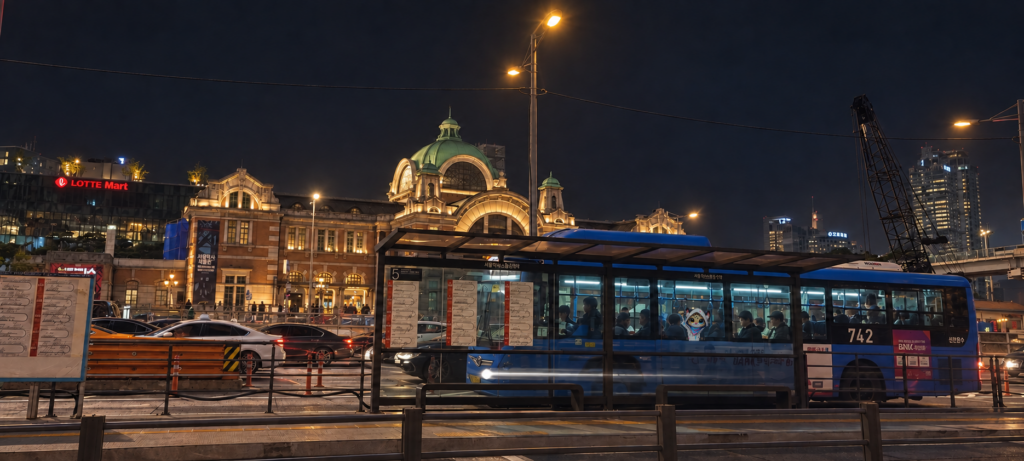
Missing the last subway does not have to end your night badly. Seoul operates overnight buses, commonly called Owl Buses, that connect major areas while the regular rail network is closed. They are useful, inexpensive and often the best way to cover the main part of a late journey before walking or taking a short taxi ride.
The catch is that a night bus is not a direct replacement for the subway. Routes are less frequent, stops may be across a wide road from where you expect them, and temporary changes can matter at 2 am. This guide explains how to make a safe decision on the night, rather than relying on a route screenshot saved months ago.
Last checked: 5 September 2026. Routes, fares, intervals and detours can change. Confirm your journey using the Seoul Metropolitan Government bus information and a live Korean transport app before leaving your venue.
The quick answer
Seoul's overnight city buses use route numbers beginning with N. If a live journey planner shows an N bus serving your destination, check all four of these details before boarding:
- The exact stop name and stop number.
- The direction of travel and the bus's final destination.
- The predicted arrival time, not only the scheduled time.
- The stop where you will get off and how you will complete the last part of the journey.
Pay with a transport card such as Tmoney where possible. Tap when you board and tap again when you leave. The second tap records the distance and allows an eligible transfer to be calculated correctly.
What is a Seoul Owl Bus?
An Owl Bus is an overnight Seoul city bus. It runs during the gap when most subway services and many ordinary bus routes are unavailable. The N prefix is the easiest visual clue that you are looking at an overnight service rather than a daytime route.
The official Seoul public transport guide describes the late-night network and publishes current payment and transfer guidance. Use that page for the rules, then use live journey information for the actual trip. A static map can explain the network, but it cannot show a delayed bus, a temporary diversion or the side of the road from which you must board.
Owl Buses generally follow long cross-city corridors. That makes them valuable for moving between a nightlife district and a central interchange, even if they do not stop beside your accommodation. A mixed journey can be practical: take the N bus for the long section, then walk through a well-lit area or use a taxi for the final short section.
How to plan your route after midnight
1. Search from the real bus stop, not just the district
Large nightlife districts contain several main roads and many similarly named stops. Set your starting point to the stop you can physically reach. Check the stop number on the sign against the number in your journey planner. If the route appears on both sides of the road, verify the destination displayed on the bus before boarding.
Navigation in Korea can behave differently from what visitors expect. Our guide to using maps in Korea explains why a Korea-focused journey planner is worth having before your night begins.
2. Check the complete journey
Do not focus only on whether an N bus arrives near you. Look at where it leaves you. A route that appears convenient may require a long uphill walk, a road crossing with limited late-night access, or another connection that has already stopped running.
Save your accommodation name and address in Korean. Take a screenshot of the final walking route while you still have battery and data. If you are staying in a building with a small entrance, save a nearby landmark as well.
3. Allow for a wait
Night buses do not arrive as often as the busiest daytime routes. A predicted arrival may also move because of traffic, road works or operational changes. Wait at the signed stop in a visible place. If the expected bus disappears from the live display, reassess instead of waiting indefinitely.
4. Board the correct direction
Match the route number and destination shown on the front of the bus. When in doubt, show the driver your destination in Korean and ask whether the bus goes there. A simple confirmation before tapping in is much easier than correcting a journey several kilometres later.
Paying and transferring
A reloadable transport card is usually the simplest option. Tap it on the reader when boarding. Tap again before or as you leave, even if the doors are busy. Failing to tap off can affect the fare and may prevent a transfer discount.
According to Seoul's current public transport guidance, the transfer window is extended to one hour during the late-night period from 9 pm to 7 am. Transfer eligibility still depends on the journey and payment method, so check the current official rules before relying on a discount.
Keep enough balance for the whole journey. Topping up can be less convenient late at night, and payment support can vary by machine and card issuer. If you are deciding between Tmoney and a time-based pass, make that choice before going out rather than at the bus stop.
When a taxi is the better choice
Choose a taxi instead when the night bus requires several uncertain connections, leaves you far from your destination, or would make a vulnerable traveller wait alone. A taxi can also be the better decision for a group when the cost is shared, although the official meter and any applicable surcharge still matter.
Before getting in, confirm the destination and keep the Korean address ready. Use a registered taxi, wear your seat belt and retain the receipt or vehicle details. If you want to compare the two options properly, read our separate late-night taxi guide once it is published.
A five-minute plan before you go out
- Save your accommodation address in Korean and English.
- Load enough value onto your transport card.
- Install and test a Korea-focused journey planner.
- Carry a charged power bank.
- Agree on a meeting point if your group becomes separated.
- Check the last subway as well as the first suitable N bus.
- Keep a taxi budget as a backup rather than assuming the bus will fit every trip.
This preparation is especially useful if Seoul nightlife is new to you. Our beginner's guide to Seoul nightlife covers the wider decisions that make a first night easier.
Common Owl Bus mistakes
The most common error is boarding the correct route in the wrong direction. The second is assuming that an N bus goes to the same stop as a daytime bus with a similar number. Other avoidable mistakes include using an old timetable image, letting a phone battery die, forgetting to tap off and choosing a route without checking the final walk.
Frequently asked questions
What time do Seoul Owl Buses run?
They operate during the overnight gap in regular public transport, but each route has its own timetable and interval. Check a live journey planner and the official Seoul transport information on the night you travel.
Can visitors use Tmoney on an N bus?
Yes, a valid Tmoney transport card can be used on Seoul buses. Tap when boarding and when leaving, and make sure the card has enough balance before late-night travel.
How long is the transfer window after 9 pm?
Seoul's official guide currently states that the transfer window is one hour between 9 pm and 7 am. Rules can change, so verify the current guidance before your trip.
Where should I check my route?
Use the Seoul Metropolitan Government information for current rules and a live Korea-focused transport app for your precise stop, direction, predicted arrival and final walk. Do not rely on an old social media graphic as your only source.
Plan a Seoul night without the transport guesswork
See SNL's current events and experiences and choose a night that fits your district, group and travel plan. Check the route home before the first drink, then enjoy the night knowing you have a realistic backup.